Ceiling Problems in Keansburg Homes, and What Each One Means
Something overhead doesn't look right, and the real question is whether it's urgent. Here is what the common ceiling problems usually mean, starting with the most urgent.
01 A bulge or sag with water behind it
Is this the urgent one? Yes. A ceiling that bulges downward, especially with a dark center or a drip, is holding water. Cut the power first. Whatever circuit feeds the lights or fans in that stretch of ceiling gets switched off at the panel. Then get people out from under it, put a bucket at the low point, and stop the water at its source if you can.
A sag without water is slower but still worth a call. Older ceilings sometimes droop between joists because the board went up with too few screws or nails, or because it absorbed humidity over many seasons. Re-fastening can work if the board is sound; otherwise that section is replaced.
02 Brown or yellow rings
What does a ring mean? Water reached the ceiling at some point. A dry, hard-edged ring that hasn't grown is usually an old leak that was fixed. A ring that darkens after rain, or feels soft, means the leak is still active. Pencil around the edge and date it; if it grows past the line, the source is still open.
With the source repaired and the board both dry and solid, the ring is coated with a stain-blocking primer and the ceiling is repainted. Regular paint on its own usually lets the brown show back through.
Here in Keansburg, storm wind is a common culprit behind roof leaks. The borough's recovery report notes that Sandy brought wind damage as well as storm surge, and wind is what lifts shingles and loosens flashing.
03 Cracks that follow the seams
Long straight cracks that cross a whole room usually track the joints between ceiling panels. The tape has come away, frequently because it was laid over too little compound or because the ceiling flexes. The fix is removing the loose tape, re-bedding new tape in compound, and spreading the coats wide so the joint doesn't read as a ridge under raking light.
04 The crack where wall meets ceiling in winter
Does a crack show up where inside walls meet the ceiling each winter, then close by summer? That pattern often comes from truss uplift. In cold months the lower framing member of each truss sits under attic insulation, staying warmer and damper than the upper members, so the truss arches and lifts the ceiling off the inside walls. It isn't a structural failure, and filling it with stiff compound just cracks again. The usual answers are a flexible bead at the joint or crown molding fixed only into the ceiling, so it rides up and down with it.
Truss uplift only happens under a trussed roof. Many Keansburg houses are older (Census survey figures put just over half of today's homes before 1960) and older roofs are more often framed with rafters, so in an older house a crack at that joint is more likely ordinary settling.
05 Popcorn texture
Can popcorn be patched? Yes, though it's tricky to blend. Matching usually means spraying a margin around the patch, and sometimes the better choice is removing the texture from the whole ceiling and skim-coating it smooth. In older homes, have a sample sent to a lab for asbestos testing before the texture is scraped, sanded or wetted.
06 Why a fresh patch looks whiter at first
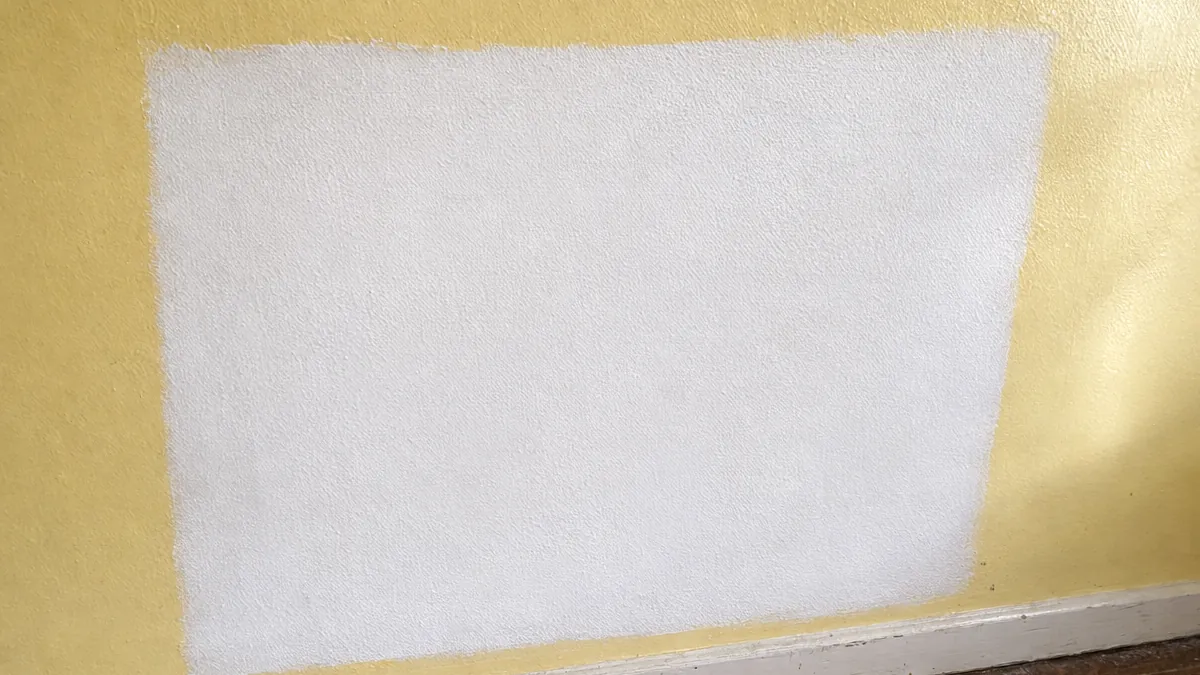
A primed patch is meant to look brighter than the wall or ceiling around it for a while. Primer seals the new compound so the topcoat soaks in evenly; without it, the repair shows as a flat, chalky square under paint. The same rule holds overhead: the patch is primed, then the ceiling is painted, ideally edge to edge.
07 When to stop reading and call
A bulge, an active drip, a stain that's spreading, a spot that gives when pressed, or a crack that grows week to week: those are worth a call now. The ceiling leak repair page explains how a water-damaged ceiling is put back together, and the page on fixing cracks in walls and ceilings covers the seam and corner cracks. Other topics are listed on the Keansburg drywall guides index.
08 Ceiling still worrying you?
Send a photo of it and say what's above that room.
A Bayshore drywall pro follows up, and the number is agreed between you before work is scheduled.