01 Asked and answered: patches, paint, dust, price
Will the new patch match the texture on my wall?
Usually, yes. Whatever is on the wall now, whether flat and smooth, a fine orange peel or the heavier knockdown many ceilings carry, gets copied, and the pattern is tried on a scrap or a primed corner first. Old hand-troweled finishes are the hard case, so mention it if your walls have one.
One small hole: worth the phone call?
Yes. A lone doorknob hole, or one crack angling off a door corner, is an ordinary job. If you have a handful of little spots in different rooms, list them all; priced as one job, each spot usually comes out cheaper than booking them one by one.
After painting, does the old damage give itself away?
That comes down mostly to primer and paint. Bare compound is thirstier than painted board, so primer goes over the patch ahead of any color; without primer it tends to look flat and dull. Aged paint is the other trap: if your wall color has faded, rolling the whole wall hides the spot much more reliably than a dab of touch-up.
How long before you get the room back?
Size and drying time decide it. A small patch often takes two or three short stops, because each coat of compound needs to harden first. A flooded lower wall takes longer, since the studs need to dry first. The quote spells out the timeline.
Dust: how much ends up on the furniture?
Some, and nearly all of it comes from sanding. A tidy job puts drop cloths over the floor and nearby furniture, and bigger jobs bring plastic sheeting and a vacuum-fed sander. If dust worries you, ask how the room will be protected when the pro calls.
What do drywall repairs run, roughly?
Thumbtack's national cost guide, updated in April 2026, puts most drywall repairs between roughly $294 and $920. That's a nationwide yardstick, not a Keansburg price. Your figure moves with the number of spots, whether the board behind is wet, wall or ceiling, and how much texture has to be copied, and you see the quote before anything starts.
02 Four repairs, one tile each
Which one fits what you're looking at? Pick the closest match. If the damage crosses over, say a leak that left both a stain and a crack, mention both and the quote covers the lot.
1Bay water, a split washer hose or a dead water heater can soak the bottom of a wall. The wet board is cut away above the point where the moisture readings turn dry, the studs get time to dry, and fresh board is hung and finished.
2A brown ring overhead is a record of water. Firm board is sealed and refinished; mushy or drooping board is trimmed to solid edges and replaced.
3Cracks along a taped joint or angling up from a door corner reappear when they are only packed with filler. Bridging them with tape and rebuilding the surface is what keeps them shut.
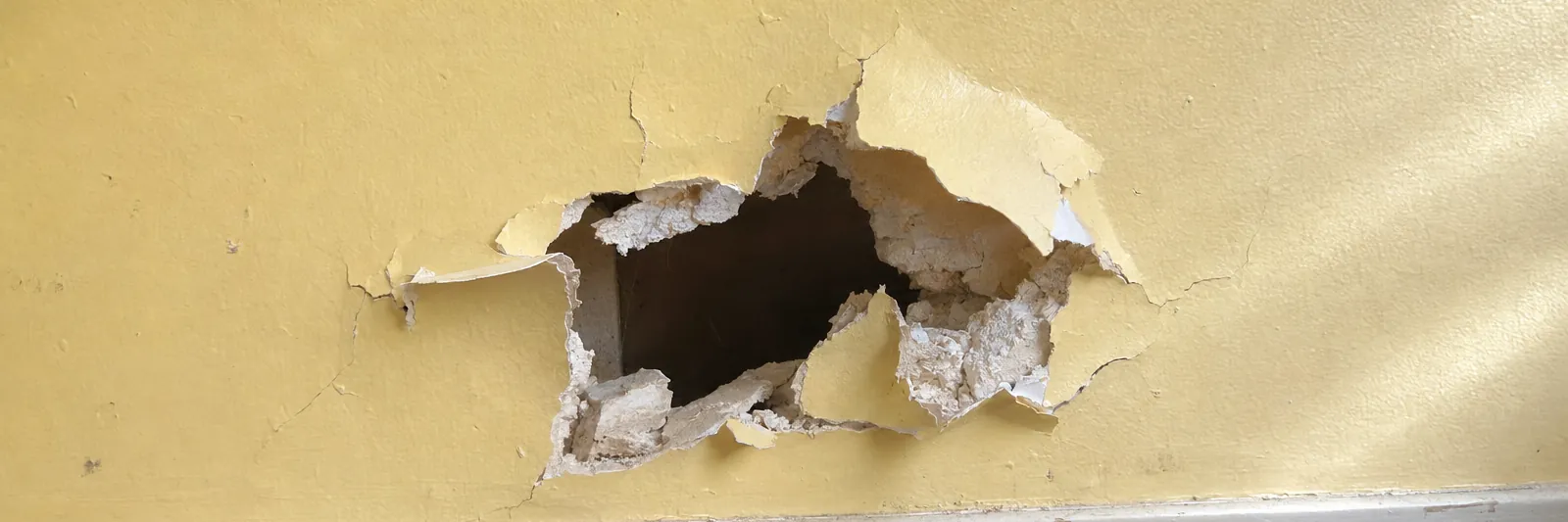
4Rewiring, a new vanity or a relocated duct leaves square cutouts and torn paper. Every opening gets backing, a snug board insert, tape and texture, so the room can be painted.
03 Read the ceiling before it drips
Not sure whether that yellow ring is old news or a live leak? Here is the short version: a ring with a hard, dry edge is usually old, a soft or darkening one is usually active, and any bulge means water is sitting on the board right now.
The ceiling guide goes further. It walks through brown and yellow stains, drooping panels, the cold-weather split along the top of inside walls, popcorn texture in older houses and the long seam cracks that cross a room, and it sorts the ones that can wait from the ones that can't.
Before you call: what each ceiling problem means
04 Three corners of town, three kinds of wall trouble
Beachway Avenue and the bayfront blocks
Is your house near the bay? The borough's own Sandy recovery report shows flooding at Highlands and Beachway Avenues and along Beacon and Shore Boulevards, and it puts flood water at two to six feet deep across about half the structures in town. So if your house took water in 2012, its lower walls have likely been opened and rebuilt at least once. What that means now: the long joint along the old cut line is a natural spot for cracks, and a fresh leak deserves a moisture reading before anything is hung over it.
The Waackaack Creek edge
The creek is Keansburg's western boundary, with Hazlet on the other bank. After the storm, the borough asked FEMA to help shore up damaged ground around the Creek Road bulkhead between Laurel and Seeley Avenues. Close to tidal water, the first thing to rule out is damp in the bottom few inches of a wall, because a patch screwed over wet framing fails from the back.
Carr Avenue and Main Street
These two streets hold most of the borough's shops and offices. The police station between Carr Avenue and Circuit Street took about a foot of surge in 2012, yet testing found its drywall wet enough to grow mold up to forty-two inches above the floor. So when you wonder how high a flooded wall should be opened, the honest answer is usually higher than the water mark.
05 Bayshore towns on the calendar too
Do you live just over the borough line? The same four repairs are booked in the neighboring towns.
- Hazlet sits across Waackaack Creek to the west and shares Keansburg's land border.
- Union Beach faces the same stretch of Raritan Bay and saw roughly 200 homes and businesses damaged in Sandy.
- Keyport, farther west on the bay, is the borough people call the Pearl of the Bayshore.
- Middletown Township borders Keansburg on the east and takes in Port Monmouth and Belford on the Sandy Hook Bay shore.
Each one has a couple of lines on the Bayshore service area page.
06 Spackle job, or one for a pro?
Can a DIY fix do it? For little things, often. Here's roughly where the line falls.
Reasonable for a Saturday
- Nail pops: sink a drywall screw a short way above or below the pop, set the old nail, then skim both with two thin coats.
- Holes no bigger than a coin: fill, sand lightly, prime, paint.
- A dent in a painted wall: build it up in thin layers; one thick fill shrinks and cracks while drying.
Time to hand it over
- Board that gives under your thumb, crumbles, or smells musty.
- Any ceiling bulge, and any ceiling hole bigger than your palm.
- A crack that reopened after you filled it.
- A texture you can't reproduce, or a wall that has had flood water against it.
07 Photos and notes for the insurer or landlord
What should you capture while the damage is still in place? Good records make things easier for the person who sorts it out later, whether that's an insurance adjuster or the person who owns your building. In Keansburg that second case is common: in the Census survey, renters occupy 1,905 homes and owners 1,832, so slightly more than half of households rent.
- One shot of the entire room, then close shots of each damaged area, tape measure included for scale.
- The height of any water line, measured up from the floor, photographed against the tape.
- For a ceiling stain, a faint pencil outline around its edge with that day's date written next to it, so you can tell later whether it spread.
- The likely source: the pipe, window, roof area or unit above, if you can see it.
- When you first spotted it, and who you told. Renters, put the notice to your landlord in writing.
Your insurer or landlord sets its own rules about what it needs; this list just keeps your record clear. It isn't advice about any claim or coverage.
08 Wiring, pipes and ducts done; walls still open
Who closes up the holes once the other trades pack up? Usually not the trade that made them. Electricians open walls to pull wire and relocate boxes, plumbers saw access holes behind tubs and vanities, HVAC installers reroute ducts and registers, and low-voltage installers leave a scatter of small holes for cable, speakers and cameras.
Closing them properly means squaring each ragged opening, adding wood backing where there's no stud to screw into, fitting a piece of board the same thickness as the wall, then taping, coating and texturing it to blend. Behind a tub or a shutoff valve, a hinged or screw-on access door often beats sealing the hole for good.
The details, opening by opening, are on the drywall patching page for remodels and trade work.